
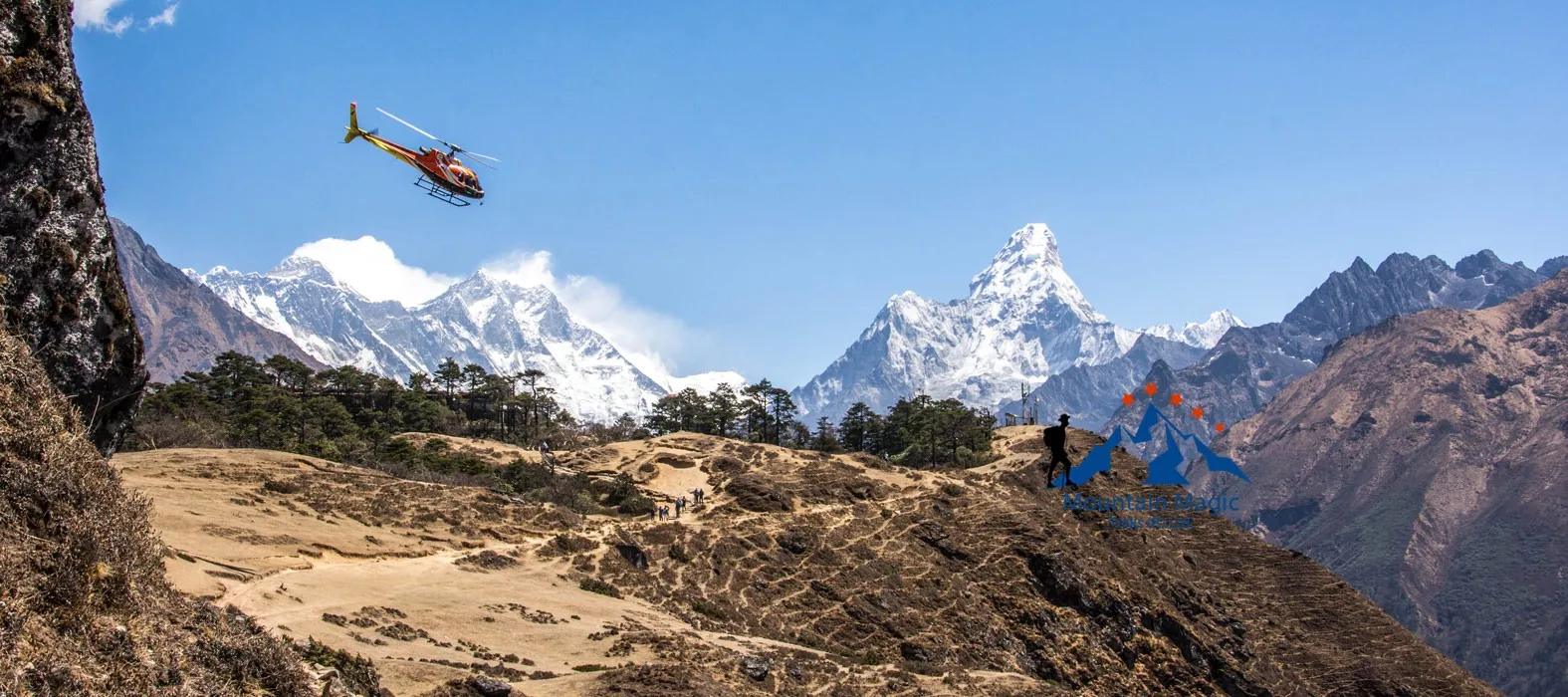
The Everest region is famous for its mountains, but the villages along the trail give the journey its real character.
As you walk from Lukla toward Everest Base Camp, the landscape changes with every few days. Green hills become high valleys, while small settlements show how people live in one of the world’s most challenging environments.
The Everest Base Camp Trek With Helicopter Return gives travelers enough time to experience this change on foot before returning from the high mountains by helicopter. The listed trip lasts 10 days and includes acclimatization in Namche Bazaar and Dingboche.
Lukla: Where the Mountain Story Begins
Lukla is more than the place where the walking starts.
For many trekkers, stepping outside the airport is the first moment when the Himalayas feel real. The busy streets of Kathmandu are gone, and the trail becomes the main way to move forward.
Notice the Change Around You
The lower Khumbu has green hills, stone houses, forests, and mountain streams.
The trail also feels active. Local people, porters, guides, and trekkers share the same paths.
Instead of rushing through Lukla, take a few minutes to look around. The village gives you your first idea of how different life in the mountains can be.
Phakding: A Gentle Introduction
The walk from Lukla to Phakding is relatively short compared with later trekking days.
The listed route is about 7 kilometers and takes around three hours.
Use This Day to Find Your Rhythm
You are still getting used to your boots, backpack, and the trail.
Walk comfortably.
Pay attention to your feet and how your body feels. There is no reason to push hard on the first walking day.
The real challenge comes later.
Namche Bazaar: The Heart of the Khumbu
Namche Bazaar is one of the best-known settlements on the Everest trail.
It sits at about 3,440 meters and serves as an important stopping point before trekkers move toward higher elevations. The itinerary includes an acclimatization day here.
Look Beyond the Shops
Namche has shops, lodges, cafes, and other services for travelers.
But it is also a working mountain community.
Look at how goods are moved through the village. Notice the homes built into the slopes. Watch local people going about their daily activities.
This gives you a better understanding of the region than simply checking Namche off your itinerary.
Tengboche: Where Culture Meets the Mountains
The trail continues toward Tengboche, a village known for its Buddhist monastery and mountain views.
The setting is impressive, but the cultural importance of the area makes it more than another viewpoint.
Spend Time at the Monastery
If you visit Tengboche Monastery, remember that it remains an active religious place.
Keep your voice low and follow local instructions.
Do not assume that every room or ceremony is open to visitors.
A respectful visit allows you to experience the culture without disturbing the people who practice it.
Dingboche: Life Above the Tree Line
Dingboche sits at about 4,410 meters.
By this point, the environment has changed noticeably. Trees are less common, the air is thinner, and the surrounding mountains appear much larger.
The itinerary includes another acclimatization day here.
See How People Adapt
Life at this altitude requires a different approach.
Buildings must handle cold conditions. Supplies need to travel long distances. Daily work is shaped by the mountain environment.
For trekkers, Dingboche is also a useful reminder that the Everest region is not simply a hiking destination.
People actually live and work here.
The Trail Gets Quieter
After Dingboche, the landscape becomes more open and rugged.
The green surroundings of the lower Khumbu are mostly behind you. Rocks, glaciers, and high mountain slopes become the main features.
Notice the Smaller Details
At this stage, the big peaks naturally attract your attention.
But look closer too.
You may see stone walls dividing fields, prayer flags beside the trail, or small shelters built for travelers.
These details make the high-altitude landscape feel less empty.
Lobuche: A Place to Pause
Lobuche is one of the last major stops before Gorakshep and Everest Base Camp.
The surroundings are much more severe than those around Lukla.
Do Not Ignore the Human Side
The route near Thukla includes memorials honoring climbers and mountaineers who died in the Everest region.
It is a quiet place.
Take a moment to understand why the memorials are there before continuing.
The mountains may look peaceful, but they demand respect.
Gorakshep: The Last Village Before Base Camp
Gorakshep sits at around 5,125 meters and is used as the base for the final approach to Everest Base Camp.
At this altitude, even simple tasks can require more effort.
Keep Your Daypack Light
When heading toward Base Camp, you do not need to carry everything you own.
Leave heavy luggage at your accommodation and take only what you need for the walk.
Useful items include:
-
Water
-
Snacks
-
Warm layers
-
Sunglasses
-
Sunscreen
-
Camera
-
Personal essentials
A lighter pack makes a difficult day easier.
Everest Base Camp: The Destination Becomes Real
The listed itinerary places Everest Base Camp at about 5,364 meters. The area offers views of the Khumbu Icefall and surrounding glaciers.
Think About the Route Behind You
When you reach Base Camp, it is easy to focus only on the famous name.
Instead, look back mentally.
You started in Lukla.
You crossed rivers and suspension bridges.
You spent time in Namche.
You visited Tengboche.
You adjusted to the altitude in Dingboche.
Now you are standing in a completely different world.
That journey is what gives Base Camp its meaning.
Kala Patthar: One Last Look at Everest
The trek also reaches Kala Patthar, listed at about 5,545 meters.
It provides wide views of Everest, Pumori, Lhotse, Nuptse, and other Himalayan peaks.
Go for the View, Stay for the Moment
Many trekkers make the early climb for sunrise.
The cold can be intense, but the changing light across the mountains can make the effort worthwhile.
Take photographs, but do not spend the entire time looking at a screen.
Stand quietly.
Look at the peaks.
This may be your last morning in the high mountains.
The Helicopter Shows the Khumbu Differently
After reaching the high points, the return journey changes completely.
The Everest Base Camp Trek With Helicopter Return uses a helicopter from the Gorakshep area toward Kathmandu. Depending on weather and wind, there may be short stops around Hotel Everest View or Namche before continuing.
Watch the Villages From Above
From the trail, you see one valley at a time.
From the helicopter, the entire region starts to make sense.
Villages become small clusters. Trails appear as thin lines. Rivers, forests, glaciers, and ridges come together in one enormous landscape.
You finally see the scale of the journey you completed on foot.
Why the Villages Matter
The Everest Base Camp Trek With Helicopter Return is often promoted around Everest itself.
But the villages between Lukla and Base Camp are what turn the route into a real journey.
They provide places to rest, eat, meet people, learn about local culture, and understand life in the Himalayas.
Without them, the trail would simply be a route between two points.
With them, it becomes an experience.
Carry the Khumbu Home With You
The biggest memory may be Everest.
But it could just as easily be a quiet morning in Namche, a monastery in Tengboche, a warm meal in Dingboche, or the view from the helicopter as the trail disappears below you.
The Everest Base Camp Trek With Helicopter Return gives you the chance to see the Khumbu from several sides: as a trekker, a visitor, and finally as an observer from the sky.
That is what makes the journey more than a trip to a famous mountain.
FAQs
How long is the trip?
The listed itinerary is 10 days from arrival to departure in Kathmandu.
Where are the main acclimatization stops?
The itinerary includes acclimatization days in Namche Bazaar and Dingboche.
What is the highest point?
Kala Patthar is listed as the highest point at approximately 5,545 meters.
Where does the helicopter return begin?
The listed plan uses pickup around Gorakshep or a nearby higher location, depending on weather and wind conditions.
Does the helicopter always fly directly to Kathmandu?
Not necessarily. Weather and wind may affect the route, and short stops around areas such as Hotel Everest View or Namche may occur.
